The forest
Lord of the FliesThe forest is not merely cover between the boys’ camps: it is where hunting becomes ritual, fear finds an apparent object, and Ralph’s later flight becomes a struggle for survival. Its dense growth can conceal the boys from one another, but it cannot keep their violence or its consequences at a distance.
Setting and Early Use
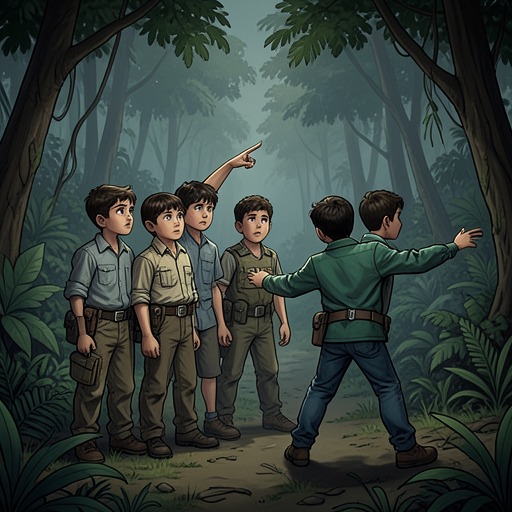
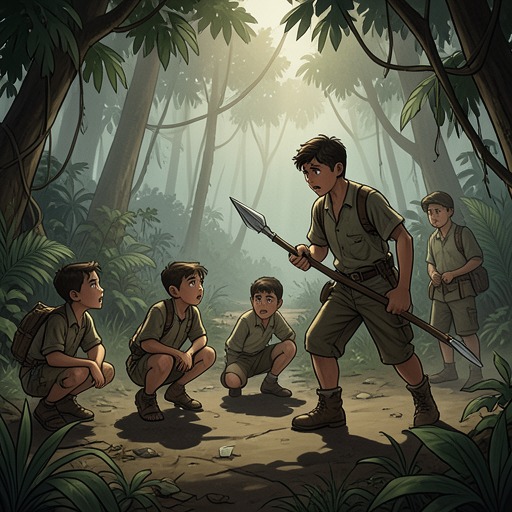
Jack Merridew reads the forest as a hunter’s terrain. He follows the scattered roots and fresh tracks that signal pigs, then leads the others down a slope toward rocks and trees by the sea. The boys creep forward in silence and heat before attacking a sow with their wooden spears. In this setting, the forest supplies food, but it also draws the group into a coordinated pursuit in which Jack directs the hunters and the animals become targets.
The Offering and Simon’s Encounter
The forest becomes a place of ceremony as well as pursuit when Jack Merridew orders part of the sow’s kill left for the beast. He has the head cut off and mounted on a stick sharpened at both ends, then declares it a gift. The other boys retreat toward the beach, leaving Simon alone among the leaves with the head, the spilled guts, and the buzzing flies. A hunt that began as a means of obtaining meat has thus produced an offering to the very fear the hunters claim they can master.
In the forest’s stillness, Simon experiences the sow’s head as speaking to him. The encounter is presented through his wavering consciousness: the head seems to mock the idea that the beast is something the boys can hunt and kill, and to identify the source of their disorder as something within them. The forest offers no reassuring boundary between perception and apparition. Simon is overwhelmed, sees a vast mouth, and loses consciousness; the vision gives the group’s imagined external threat a disturbing inward meaning.
The Forest as Refuge and Trap
Simon’s emergence from the forest brings the hidden truth about the beast into the boys’ circle of ritual violence. During the storm, Jack Merridew leads a dance in which the boys chant and circle, seeking safety in the group as the weather and their fear intensify. Simon stumbles out of the trees crying that the beast is a dead man on the hill, but the crowd mistakes him for the threat it has imagined and attacks him. The forest has concealed him, yet its edge becomes the threshold through which the truth enters a gathering unable to recognize it.
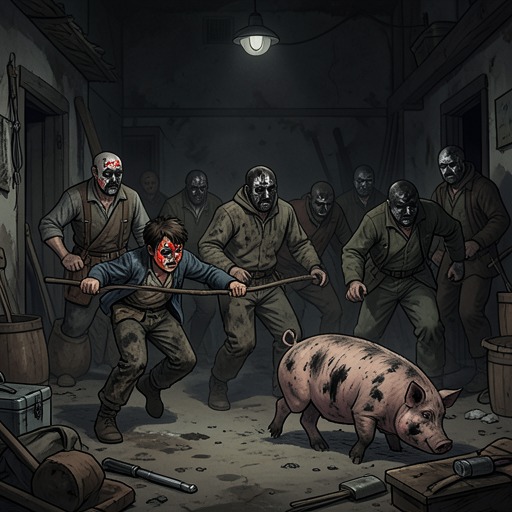
Later, the same cover that shelters Ralph also makes his survival precarious. Wounded in the flight from Jack Merridew’s tribe, with bruises and a swollen spear wound across his right ribs, Ralph hides near Castle Rock and listens for pursuit. He distinguishes the painted hunters from the boys he remembers, while the forest’s shadows offer concealment without security. When the tribe sets the forest alight to smoke him out, Ralph must find a deeper thicket: he worms beneath a mat of creepers into darkness, hoping to remain unseen or break through the line if discovered. The forest’s cover becomes a temporary refuge inside a landscape turned into a weapon against him.
The Forest as an Uncertain Presence
During the assembly about the beast, the forest presses on the boys’ discussion without yielding any evidence of a creature. Wind stirs the palms, and two grey trunks rub together with a squeak that seems sinister in the darkness, though no one had noticed it by day. The sound makes the surrounding landscape available to fear: an ordinary movement becomes suggestive when the boys cannot see its source clearly. Ralph tries to postpone the ghost debate until daylight, but the forest’s noises have already helped turn uncertainty into apparent threat.